
Best responses to disruption may require a different kind of resilience.
The shock of the Pandemic and the resulting uncertainty across the economy and our society are well-documented. They have followed hard on the heels of a self-authored, 3-year, catastrophic shift by the people of the UK, to write our own economic doom and waste everyone's productive time with Brexit uncertainty. Not to mention what austerity slash-and-burn measures did to our social safety nets. No surprise then that resilience has become a supermassive hot topic.
Along the way of my endless studying, I have come across some very helpful ways to think about resilience, which I have brought together in my coaching approach on the topic. They're not simple and take a more little explaining, but my clients report that they are highly effective. In this post I describe the main part of that approach, which I use when I become aware of discounting or blindspots in a client's approach to what we have contracted to work on. This is common, and an important part of leadership development, and so many of my clients will have worked through this with me.
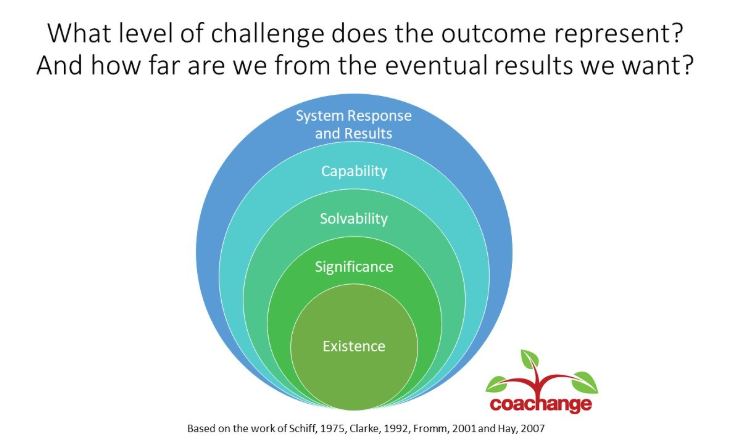
By explaining the levels of discounting above, and by bringing into awareness current patterns of feeling and thinking, I use questions to help us get started into a more useful set of conversations. The questions I am holding in my head and quietly seeking to learn as we work are: How do you, my client, frame and define the challenge that you are facing, regarding your resilience? And how does this broaden or narrow the types of response or adaptation you can create?
At some point, there is a distinction to make, in the kind of solution we seek and the level of change we are willing to undertake.
On the one hand, we could work on a static response to disruption in the environment. This could involve learning a new skill, trying out a new set of behaviours or a strategy to cope. After a period we would return to normal, hence the name static response.
Or on the other, we could work on a dynamic adaptation to disruption in the environment. This could involve a more seismic change and require a deeper psychological shift from us, such as rethinking our underlying beliefs or even an identity reinvention. We tend not to go back to how we were before. These changes are easier to make when supported in a non-judgemental frame by an individual you trust
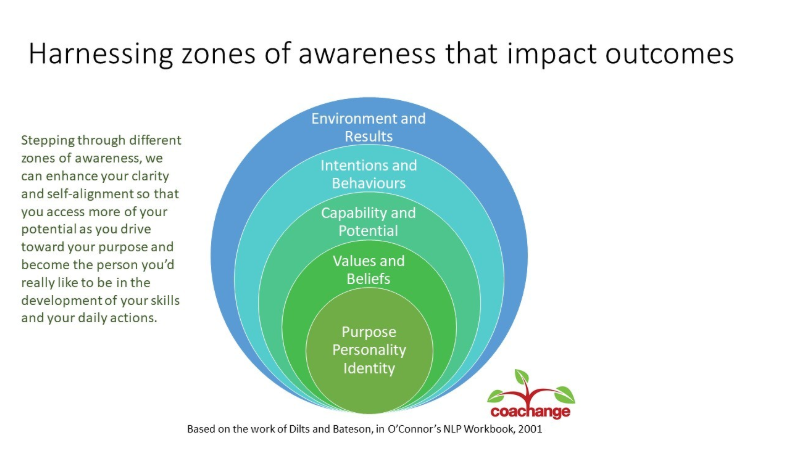
One frame or process which I have adapted from Dilts and Bateson, is shown above. A coach who has trained in a similar TA or NLP process can step you through the levels and leave you feeling clear and energised for defined and purposeful action.
Actions are easier to enact over time, when orchestrated with other aligned individuals or better still with a group or a whole society, so conversations to engage others to join you are central to leadership.
Disruption that calls into question the values or purpose of an individual, organisation or society, require change at these deeper levels, to be effective. However, to quote Julie Hay, in Reflective Practice and Supervision for Coaches, "discounting at this level means that no change will occur until [the person/group/society] is able to bring the situational factors [that exist] into awareness." We usually cannot see how we discount parts of the problem without others to tell us, show us or model for us in some way.
For me this explains so much about what I am doing in my work, raising to awareness the frame within which people are holding their challenges, and thus allowing them to examine how they feel about that frame and whether another frame might help them adapt existentially to how society and the planet is changing.
Tom Rivett-Carnac in his TED talk about "what it takes to make (climate) change happen", is passionate in his explanation that even when we cannot control the outcome, or feel connected directly to it, our contribution can be hugely meaningful. He describes how purposeful behaviours toward change can be satisfying and sustained, if the actions are led from a deep and supporting attitude. Paraphrasing again, he is saying that: consistent meaningful action by a few can bring a whole society to follow and to sustain dedicated action until the effects are adequate to reach that positive tipping point.
He talks about gritty determination and grounded optimism.. These, I feel, are possible only when all the levels of accounting are aligned.
I hope you have found this article interesting and have a little insight into what it is that I am doing with my clients that makes such a valuable difference around resilience.