
The heaven and hell of relationships
Adapted from original published in Jan 2016
Though it can feel lonely at the top, Senior Leadership is defined by the quality of relationships that can be built and maintained. In acquisitions and mergers identified synergies can only be realised through great relationships. As professional executive coaches, much of Lorenza Clifford and Andy King's work is about building positive enduring relationships between leaders, their people, their stakeholders and their clients. In this brief article they describe a simple model that has helped many senior leaders to consider how to improve their relationships and then to act on their realisations.
The authors were part of informal field research groups in 2008 - 2010 experimenting with Clean language, emergent knowledge, power of six and other "Clean-ish" techniques at the less directive end of the coaching spectrum. They shared what they noticed as they worked, inquired into each other’s practices, modelling what seemed to work valuably for clients and discussing how to create the conditions for useful insight and lasting change.
One aspect that arose regularly in these conversations was a theme of raising awareness of what is occurring in relationships. Another was about developing and sustaining choiceful intentions in the moment. When things went badly in relationships it seems that people got sucked into upsets ‘through the door of perceived criticism’. Once there, they found it difficult to see things clearly or to escape a spiral of negative emotions and intentions and actions.
The Clifford-King model, is based upon some key features of relationships, that predict survival and thriving or failure. Described by couples’ counsellors in the 1960s and referred to as "the four horsemen of the apocalypse" (Gottman), key negative indicators for a relationship were criticism, defensiveness and stonewalling. Where present in relationships, they were experienced negatively and where contempt was present, the relationship rarely survived.
This tallied with the authors' experience in workplaces where they were working to improve relationships in teams that were either just starting out, or where relationships were already existing, but experienced as tricky.
They then experimented with a way of working to help leaders to take responsibility for what occurs in their relationships around the four negative areas. They developed questions that allow individual leaders or groups to explore and bring into awareness what they were actually thinking, feeling and doing.
This was helpful and revealing on its own, but the authors were concerned about only focussing on the areas that bring negative emotions and outcomes. So they developed the process further around "four white knights" for relationships. These were appreciation, open-mindedness, engagement and the ultimate good omen, respect. Again, questions were used to encourage 100% responsibility for exploring and creating these key positive features that bring positive emotion. When used together, this process was at first deep and revealing, then inspirational and pragmatic.
Since then, there have been further developments including Andy King's insight that for brief interventions, it helps to present the model as a spiral, offering people a new perspective and a clear choice point about how they want to move forward. Presenting it visually appears to speed up access to the insights and awareness piece, we’ve noticed.
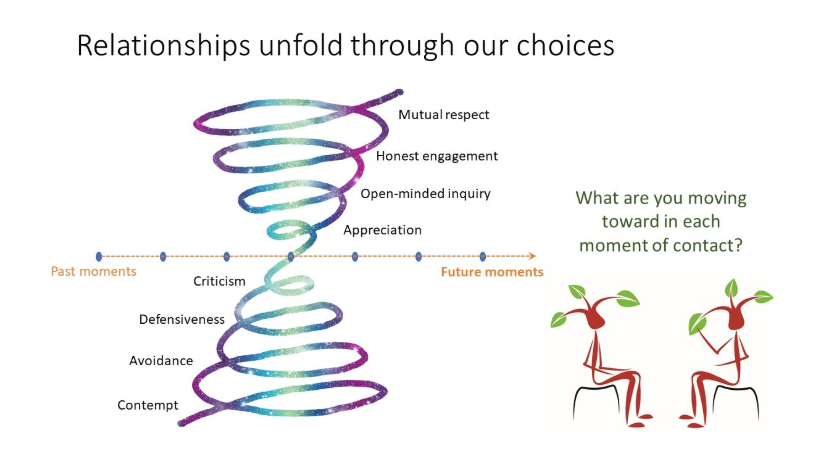
As an aside for coaches who are interested in such jargon, this approach can be considered more cognitive-behavioural than clean, yet, with skill, can still be low-directive, and is true to the universal notion that the potential for “heaven or hell” in a relationship is contained in every moment of contact and is in the hands of both parties.
Both authors are interested in developing new ways of working with what happens in the moments of contact. Time marches on. For humans, not forever. Any point of contact contains choice points that are defined by the intentions, awareness and self-control of the individuals concerned.
As coaches, we learn ourselves through reflection. It is our gift to help others learn, through reflecting on:
how they currently work
current outcomes they get
what they really want to have happen
ways they might experiment with
their own internal resources to achieve that.
As they go through the process with our support, they develop their own insights and learn ways to support themselves in the future.
About the authors:
Lorenza Clifford, Coachange: Developing leaders and coaches internationally, Lorenza.clifford@coachange.org
Coachange focuses on organisations that want to develop their culture to enable learning, creativity and unlock the potential of their people.
Andy King, MD of Kingsight, andywking@btinternet.com
Kingsight offers coaching for individuals and teams who want to achieve better outcomes.